
College of Engineering and Architecture

The department is proud of its consistently high performance by its graduates, garnering 100% passing rate in the board examination in 2016 up to February in 2018, to cite an example. This amazing achievement testifies to the quality of education that the Department provides to its primary clients, the students.
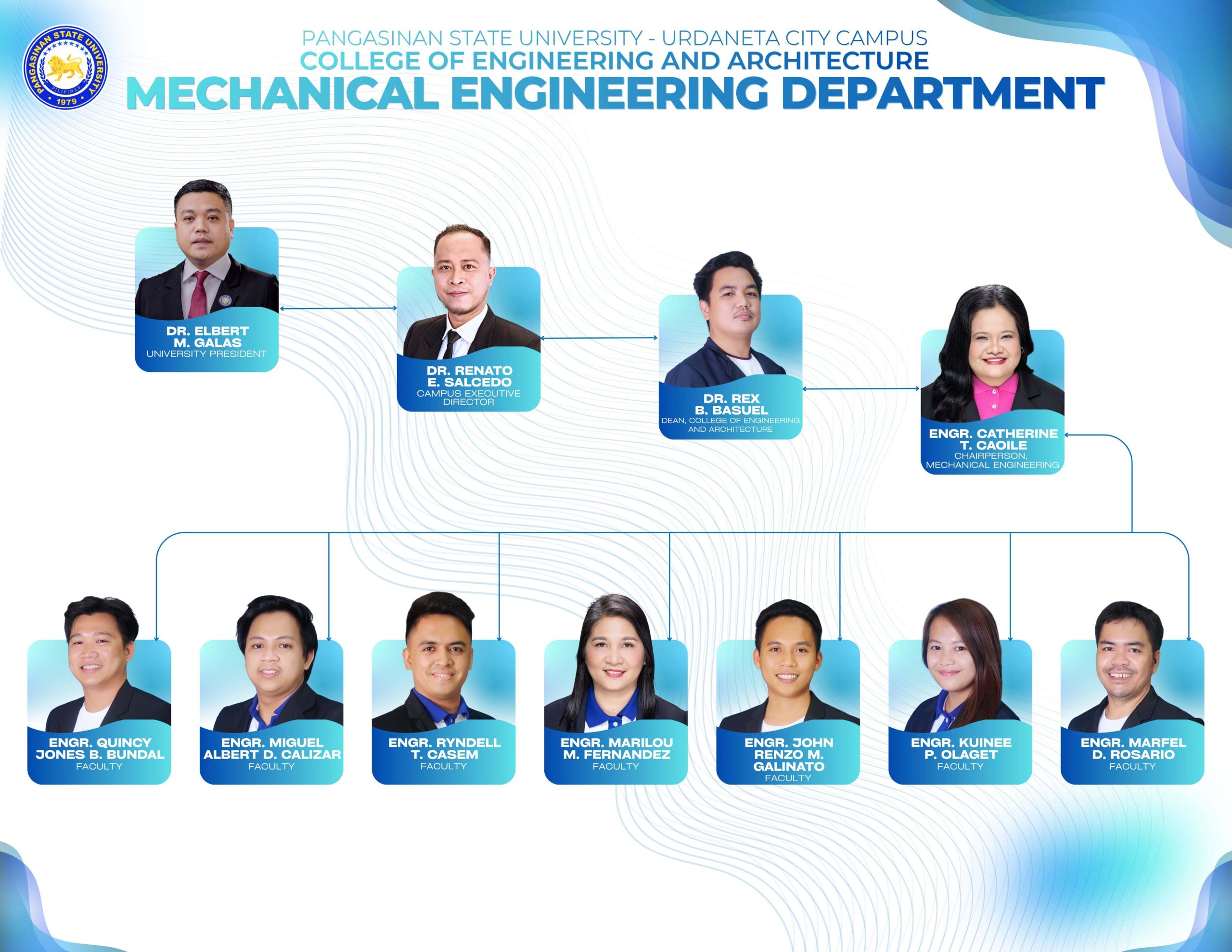
Behind the success of the ME Department is the concerted effort of its well-seasoned educators whose teaching skills are perfected by time and experience, along with up-to-date knowledge of mechanical engineering. To date, the faculty of the department is composed of young but promising, licensed mechanical engineers headed by a hardworking Department Chairperson and versatile along with the Dean of the College of Engineering and Architecture.
Inspired by the vision and mission of the university, the ME Department is unstoppable in its quest for excellence, and in delivering the services which the Pangasinan State University is committed to render, namely, instruction, research, extension, and production.
Recognition
Program Educational Objectives
The Bachelor of Science in Mechanical Engineering (BSME) is a four-year degree program leading to a degree in one of the most diverse engineering disciplines which deals with the design, development, installation, operation and maintenance of anything that has moving parts such as machinery, engines, and structures used in industrial, biomedical, instrumentation and transportation systems.
Program Educational Objectives
By 3- to 5 years after graduation, the graduates of mechanical engineering program should have:
-
- Possessed essential and fundamental mechanical engineering knowledge and skills that make them confident to work as a mechanical engineer in local, national and international work environment.
- Engaged in professional careers through ethical behavior, global excellence and communicative competency.
- Assumed managerial and leadership roles in their organizations and multi-sectoral communities.
- Exhibited life-long learning through a comprehensive, continuous and relevant non-formal education program.
- Pursued graduate program and engage in academic and research careers.
- Engaged in an economic enterprise related to the profession.
Program Outcome
| Graduate Attribute | Program Outcomes | Performance Indicators |
| People’s Champion | PO1:Demonstrate through institutional mechanisms, system, policies, and processes which are reflective of transparency, equity, participatory decision making, and accountability.
PO2: Engagein relevant, comprehensive, and sustainable development initiatives through multiple perspectives in decisions and actions that build personal and professional credibility and integrity.
PO3: Setchallenging goals and tasks with determination and sense of urgency which provide continuous improvement and producing quality outputs leading to inclusive growth.
PO4: Exhibitlife-long learning and global competence proficiency in communication skills, intra/interpersonal skills, entrepreneurial skills, innovative mindset, research and production initiatives and capability in meeting industry requirements of local, ASEAN and international human capital market through relevant and comprehensive programs.
PO5: Display, socially and environmentally responsive organizational culture, which ensures higher productivity among the university constituents and elevates the welfare of the multi-sectoral communities.
PO6: Practice spiritual values and morally upright behavior which promote and inspire greater harmony to project a credible public image.
PO7: Graduates of State Universities and Colleges must, in addition, have the competencies to support “national, regional and local developments plans”.
PO8: Articulate and discuss the latest development in the specific field of practice.
PO10: Work effectively and independently in multi-disciplinary and multi-cultural teams.
PO11: Act in recognition of professional, social, and ethical responsibility.
PO d: Function in multidisciplinary and multi-cultural teams.
PO f: Practice professional and ethical responsibility.
PO g: Communicate effectively
PO k: Use techniques, skills, and modern engineering tools necessary for mechanical engineering practice
PO l: Plan as a member and leader of a team to manage projects in a multidisciplinary environment by applying engineering and management principles.
|
PI 1. Follow the Mechanical Engineering laws and code of ethics.
PI 2. Perform given tasks with adherence to professional and ethical standards PI 3. Demonstrate commitment to teamwork while working with others in multidisciplinary teams PI 4. Obtain knowledge and information which focuses on how global, economic, environmental, and social issues impact the design of an engineering and architecture project. PI 5. Active membership in professional organization and active participation in the various activities relating to the Mechanical Engineering Profession. PI 6. Perform given tasks with adherence to professional and ethical standards PI 7. Propose and defend mechanical engineering and architecture projects. PI 8. Defend the impact of the proposed project in a global, economic, environmental, and societal context. PI 9. Allocate time for personal and professional development through participation in technical seminars and workshops, read engineering materials regularly, and engage in engineering research and pursue graduate studies. PI 10. Active membership in professional organization and active participation in the various activities relating to the mechanical engineering profession PI 11. Recognize the need in life-long learning and to engage in continuing professional development of engineering skills locally or globally through participation in conferences, seminars, workshops, and self-study PI 12. Obtain knowledge and information which focuses on how global, economic, environmental, and social issues impact the design of an engineering project. PI 13. Recognize the need in life-long learning and to engage in continuing professional development of engineering skills locally or globally through participation in conferences, seminars, workshops, and self-study. PI 14. Active membership in professional organization and active participation in the various activities relating to the mechanical engineering profession. PI 15. Design solutions for complex engineering problems and design systems, components or processes that meet specified needs with appropriate consideration for public health and safety, cultural, societal, and environmental considerations. PI 16. Active membership in professional organization and active participation in the various activities relating to the mechanical engineering profession PI 17. Demonstrate commitment to teamwork while working with others in multidisciplinary teams PI 18. Be familiar with the code of ethics for engineers and apply and behave according to this code of professional practice. PI 19. Perform given task with adherence to professional and ethical standards PI 20. Act professionally and ethically and recognize the impact of liability issues in engineering projects that uphold the dignity of the mechanical engineering profession PI 21. Apply professional and ethical responsibility (e.g., safety, environmental, legal, regulatory, intellectual property, project management, risk management). PI 22. Preserves the ethical and integrity of the mechanical engineering profession. PI 23. Develop a sense of professional responsibility & leadership in a multidisciplinary setting PI 24. Adapt innovations which focus on the social and global impact in the engineering industry.
PI 25. Apply improvements in mechanical engineering practice.
PI 26. Integrate developments through involvement in research and extension activities. PI 27. Demonstrate commitment to teamwork while working with others in multidisciplinary and multi-cultural teams
PI 28. Perform effectively in multi-disciplinary projects and other areas of specialization.
PI 29. Execute group work, experiments, and projects. PI 30. Apply professional and ethical responsibility (e.g., safety, environmental, legal, regulatory, intellectual property, project management, risk management).
PI 31. Preserves the ethical and integrity of the engineering and architecture profession.
PI 32. Develop a sense of professional responsibility and leadership in a multidisciplinary setting. PI 33. Demonstrate commitment to teamwork while working with others in multidisciplinary and multi-cultural teams PI 34. Function effectively in multi-disciplinary project and mechanical engineering teams. PI 35. Perform group work, experiments, and projects. PI 36. Act professionally and ethically and recognize the impact of liability issues in mechanical engineering projects that uphold the dignity of the Mechanical Engineering profession. PI 37. Follow the Mechanical Engineering laws and code of ethics. PI 38. Perform given tasks with adherence to professional and ethical standards PI 39. Propose and defend mechanical engineering projects. PI 40. Demonstrate technical writing and public speaking abilities PI 41. Express ideas orally and through written means PI 42. Illustrate appropriate software in mechanical engineering design PI 43. Perform engineering calculations by use of modern tools, equipment, and software needed for engineering practice. PI 44. Utilize techniques and skills using modern engineering methods and tools needed in mechanical engineering practices. PI 45. Propose and defend mechanical engineering projects PI 46. Apply academic theory into engineering proposals to solve engineering problems PI 47. Demonstrate commitment to teamwork while working with others in multidisciplinary and multi-cultural teams PI 48. Function effectively in multi-disciplinary project and mechanical engineering teams. PI 49. Perform group works, experiments, and projects.
|
| Continuous-Innovative Learner | PO3: Set challenging goals and tasks with determination and sense of urgency which provide continuous improvement and producing quality outputs leading to inclusive growth.
PO4: Exhibit life-long learning and global competency proficiency in communication skills, inter/interpersonal skills, entrepreneurial skills, innovative mindset, research and production initiatives and capability in meeting the industry requirements of local, ASEAN and international human capital market through relevant and comprehensive programs.
PO9: Effectively communicate orally and in writing using both Mother Tongue and English and Filipino.
PO a: Solve mechanical engineering problems by applying knowledge of mathematics and science
PO b: Design and conduct experiments as well as analyze and interpret data.
PO c: Designa system component or process to meet desired needs within realistic constraints in accordance with standards
PO e: Identify, formulate, and solve mechanical engineering problems
PO i: Engage in life-long learning and keep abreast with the developments in Mechanical Engineering.
PO j: Appropriately act on contemporary issues.
PO 13: Contribute to the generation of new knowledge by participating in various research and development projects. |
PI 1. Propose and defend mechanical engineering and architecture project.
PI 2. Defend the impact of the proposed project in a global, economic, environmental, and societal context. PI 3. Allocate time for personal and professional development thru participation in technical seminars and workshops, read engineering materials regularly, and engage in engineering research and pursue graduate studies. PI 4. Active membership in professional organization and active participations in the various activities relating to the mechanical engineering profession. PI 5. Recognize the need in life-long learning and to engage in continuing professional development of engineering skills locally or globally through participation in conferences, seminars, workshops, and self-study PI 6. Obtain knowledge and information which focuses on how global, economic, environmental, and social issues impact the design of an engineering project. PI 7. Recognize the need in life-long learning and to engage in continuing professional development of engineering skills locally or globally through participation in conferences, seminars, workshops, and self-study. PI 8. Active membership in professional organization and active participations in the various activities relating to the mechanical engineering profession. PI 9. Discuss professional oral and written presentation effectively. PI 10. Express mechanical engineering ideas orally through written means. PI 11. Propose and defend engineering and architecture projects PI 12. Apply mathematical methods in solving engineering problems PI 13. Use fundamental concepts and theories of science in the formulation of engineering problems. PI 14. Perform mathematics and mechanical engineering calculations PI 15. Perform testing/experiments, analyze, and interpret results/data in the laboratory setting. PI 16. Apply academic theory into engineering proposals to solve engineering problems PI 17. Articulate mechanical engineering ideas or problems in sketches, drawing or diagrams effectively by analyzing and interpreting the data and use engineering judgement to draw conclusions. PI 18. Design optimum system and component of mechanical engineering facilities and infrastructures to meet desired needs within realistic constraints in accordance with the applicable standards. PI 19. Propose and defend a mechanical engineering project for efficient and safe implementation of design PI 20. Use of engineering techniques to evaluate design performance vs. prescribed constraints (cost, environment, safety etc.) PI 21. Evaluate engineering calculations manually and by use of applicable software PI 22. Apply proper and accurate transformations of science and engineering problems into solvable mathematical models. PI 23. Solve problems using engineering methods, tools and instruments. PI 24. Apply academic theory into engineering proposals to solve engineering problems PI 25. Allocate time for personal and professional development through participation in technical seminars and workshops, read engineering materials regularly, and engage in engineering research and pursue graduate studies. PI 26. Active membership in professional organization and active participation in the various activities relating to the mechanical engineering profession. PI 27. Recognize the need in life-long learning and to engage in continuing professional development of engineering skills locally or globally through participation in conferences, seminars, workshops, and self-study PI 28. Competent in addressing the needs for technology transfer. PI 29. Demonstrate peer-recognized expertise together with the ability to articulate that expertise and use it for contemporary issues and problem solving in the analysis, design, and evaluation of mechanical engineering projects PI 30. Utilize techniques and skills using modern engineering methods and tools needed in mechanical engineering practices. PI 31. Involve in engineering and architecture technical research studies to develop personal growth.
PI 32. Engage in various development projects to augment professional knowledge in the field of specialization.
PI 33. Demonstrate new ideas by utilizing the new software and technologies. |
| Community Developer | PO5: Display, socially and environmentally responsive organizational culture, which ensures higher productivity among the university constituents and elevate the welfare of the multi-sectoral communities.
PO6: Practicespiritual values and morally upright behavior which promote and inspire greater harmony to project a credible public image.
PO12: Preserve and promote “Filipino historical and cultural heritage”
PO c: Design a system component or process to meet desired needs within realistic constraints in accordance with standards
PO d: Function in multidisciplinary and multi-cultural teams
Po f: Practiceprofessional and ethical responsibility
PO h: Innovate engineering solutions that will bring impact in a global, economic, environmental, and societal context.
PO j:Appropriately act on contemporary issues.
PO7:Graduates of State Universities and Colleges must, in addition, have the competencies to support national, regional and local developments plans”. |
PI 1. Design solutions for complex engineering problems and design systems, components or processes that meet specified needs with appropriate consideration for public health and safety, cultural, societal, and environmental considerations.
PI 2. Active membership in professional organization and active participations in the various activities relating to the mechanical engineering profession PI 3. Demonstrate commitment to teamwork while working with others in multidisciplinary teams PI 4. Be familiar with the code of ethics for engineers and apply and behave according to this code of professional practice. PI 5. Perform given task with adherence to professional and ethical standards PI 6. Act professionally and ethically and recognize the impact of liability issues in engineering projects that upholds the dignity of the mechanical engineering profession PI 7. Promote and apply environmental laws and regulations as provided by the National Building Code of the Philippines. PI 8. Incorporate multi-sectoral equality on design considerations PI 9. Ensure elevated welfare of university constituents in design practice for higher productivity. PI 10. Design optimum system and component of mechanical engineering facilities and infrastructures to meet desired needs within realistic constraints in accordance with the applicable standards. PI 11. Propose and defend a mechanical engineering project for efficient and safe implementation of design PI 12. Use of engineering techniques to evaluate design performance vs. prescribed constraints (cost, environment, safety etc.) PI 13. Demonstrate commitment to teamwork while working with others in multidisciplinary and multi-cultural teams PI 14. Function effectively in multi-disciplinary project and mechanical engineering teams. PI 15. Perform group works, experiments, and projects. PI 16. Act professionally and ethically and recognize the impact of liability issues in mechanical engineering projects that upholds the dignity of the Mechanical Engineering profession. PI 17. Follow the Mechanical Engineering laws and code of ethics. PI 18. Perform given tasks with adherence to professional and ethical standards PI 19. Propose and defend mechanical engineering projects. PI 20. Defend the impact of the proposed project in a global, economic, environmental, and societal context. PI 21. Obtain knowledge and information which focuses on how global, economic, environmental, and social issues impact the design of a mechanical engineering project. PI 22. Competent in addressing the needs for technology transfer. PI 23. Demonstrate peer-recognized expertise together with the ability to articulate that expertise and use it for contemporary issues and problem solving in the analysis, design, and evaluation of mechanical engineering projects PI 24. Utilize techniques and skills using modern engineering methods and tools needed in mechanical engineering practices. PI 25. Apply professional and ethical responsibility (e.g., safety, environmental, legal, regulatory, intellectual property, project management, risk management). PI 26. Preserves the ethical and integrity of the mechanical engineering profession. PI 27. Develop a sense of professional responsibility & leadership in a multidisciplinary setting |