
College of Engineering and Architecture

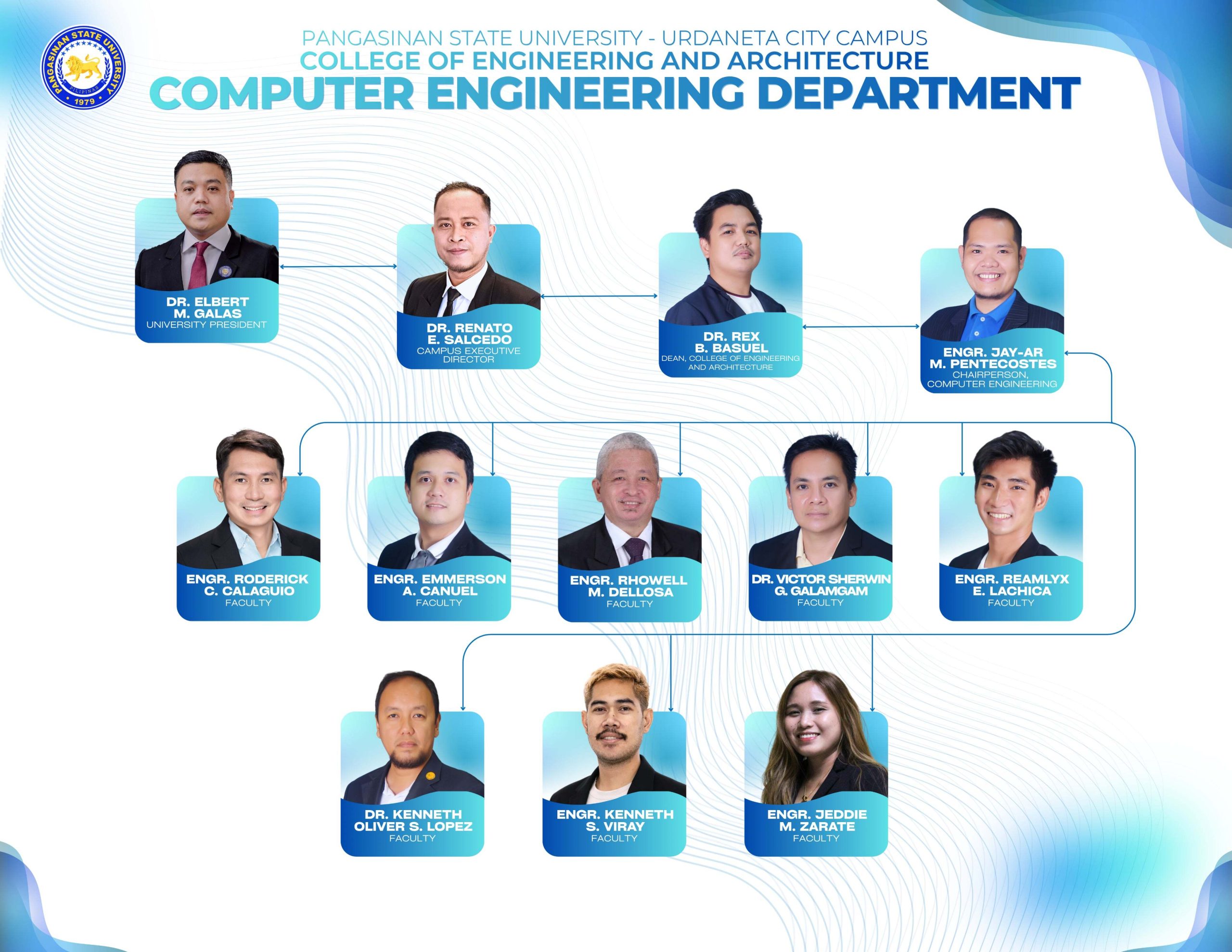
The Computer Engineering Department is home to highly qualified educators that are committed to honing students to become world-class computer engineers.
As more and more sectors are becoming dependent on computer technology, the COE Department will continue to keep abreast of the latest computer technology, in order to better equip the learners with vast knowledge preparing them to be of service to the community.
The Computer Engineering Department takes it as a responsibility to educate students with the desire to improve the quality of their family lives and the people in the community. The members of the faculty work without let up, as they believe that giving quality education is a noble way to make a difference in society.
Recognition
Program Educational Objectives
Three (3) to five (5) years after graduation, graduates of the Bachelor of Science in Computer Engineering program should;
- be globally competitive in the field of Computer Engineering;
- be equipped with necessary and relevant technical competencies that are contributory to national development.
- be able to demonstrate managerial and leadership roles in their organizations and multi-sectoral communities.
- be able to exhibit high levels of professionalism and ethical responsibility and work collaboratively.
- be a lifelong learner that are imbued with the Pangasinan State University core values
Program Outcome
| GRADUATE ATTRIBUTES | PROGRAM OUTCOMES | PERFORMANCE INDICATORS |
| People’s Champion
Continuous-Innovative Learner
Community Developer |
PO 1. Demonstrate through institutional mechanisms, systems, policies, and processes which Pare reflective of transparency, equity, participatory decision making, and accountability – ILO |
|
| PO 2. Engage in relevant, comprehensive, and sustainable development initiatives through multiple perspectives in decisions and actions that build personal and professional credibility and integrity. – ILO |
|
|
| PO 3. Set challenging goals and tasks with determination and sense of urgency which provide continuous improvement and producing quality outputs leading to inclusive growth. – ILO |
|
|
| PO 4. Exhibit life-long learning and global competency proficiency in communication skills, inter/interpersonal skills, entrepreneurial skills, innovative mindset, research and production initiatives and capability in meeting the industry requirements of local, ASEAN and international human capital market through relevant and comprehensive programs.- ILO |
|
|
| PO 5. Display, socially and environmentally responsive organizational culture, which ensures higher productivity among the university constituents and elevate the welfare of the multi-sectoral communities. – ILO |
|
|
| PO 6. Practice spiritual values and morally upright behavior which promote and inspire greater harmony to project a credible public image.- ILO |
|
|
| PO 7. Graduates of State Universities and Colleges and Local Universities and Colleges must, in addition, have the competencies to support “national, regional and local development plans”.(RA 7722). (CMO 92, series 2017). – ILO |
|
|
| PO 8. Articulate and discuss the latest developments in the specific field of practice (PQF Level 6 Descriptor). |
|
|
| PO 9. Effectively communicate orally and in writing using Mother Tongue, English and Filipino. |
|
|
| PO 10. Work effectively and independently in multi-disciplinary and multi-cultural teams (PQF Level 6 Descriptor). |
|
|
| PO 11. Act in recognition of professional, social, and ethical responsibility. |
|
|
| PO 12. Preserve and promote “Filipino historical and cultural heritage” (based on RA 7722) |
|
|
| PO 13. Contribute to the generation of new knowledge by participating in various research and development projects. |
|
|
| People’s Champion
Continuous-Innovative Learner
Community Developer |
PO a. Solve complex engineering problems by applying knowledge of mathematics and science |
Execute mathematics and civil engineering calculations and analysis. |
| PO b. Design and conduct experiments as well as to analyze and interpret data |
|
|
| PO c. Design a system component or process to meet desired needs within realistic constraints in accordance with standards |
|
|
| PO d. Function in multi-disciplinary and multi-cultural teams. |
|
|
| PO e. Identify, formulate and solve complex problems in Civil Engineering |
|
|
| PO f. Understand professional and ethical responsibility |
|
|
| PO g. Communicate effectively; | · Communicate professional oral and written presentations effectively.
· Formulate civil engineering ideas orally and through written means effectively. |
|
| PO h. Innovative engineering solutions that will bring impact in a global, economic, environmental, and societal context |
|
|
| PO i. Engage in life-long learning and keep abreast with the developments in Civil Engineering; |
|
|
| PO j. Know contemporary issues
|
|
|
| PO k. Use techniques, skills, and modern engineering tools necessary for Civil Engineering practice |
|
|
| PO l. Know and understand engineering and management principles as a member and leader of a team, and to manage projects in a multidisciplinary environment |
|
|
| PO m. Understand at least one specialized field of civil engineering practice |
|