
College of Engineering and Architecture

The Architecture Department welcomes you and invites you to stay awhile and feel free to know what sets this department apart.
The Bachelor of Science in Architecture was one of the courses initially offered when PSU-Urdaneta Campus was established as a full-fledged campus. So, the phenomenal growth of the campus can also be attributable to the Architecture Department.
Armed with noble goals and objectives, the department envisions to be one of the top producers of high-caliber Architects that are equipped with holistic education, ready to respond to the ever-changing needs of the community in terms of architectural design, innovation, and creativity.
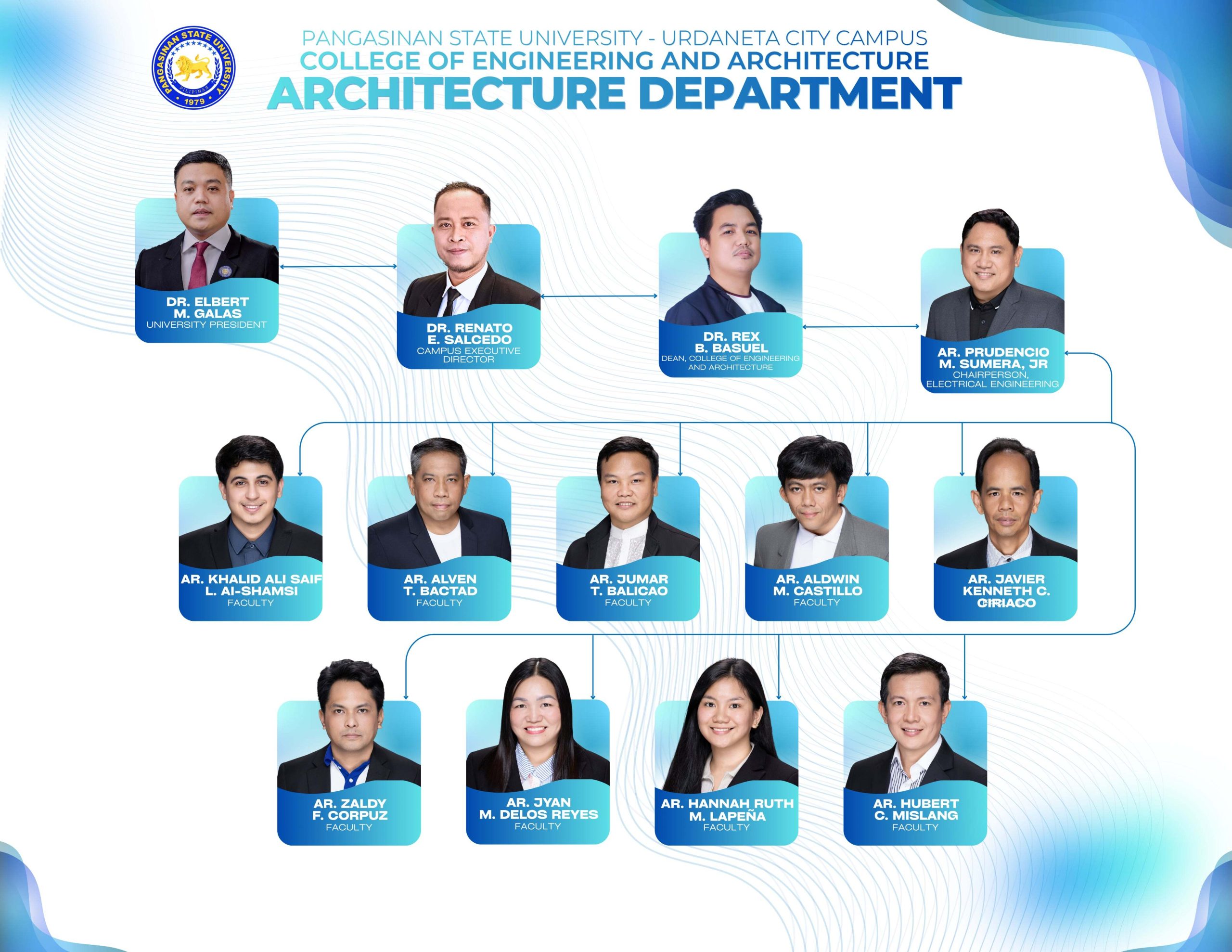
Over the years, the department made a name by way of producing topnotchers. As a result, more and more students from all corners of Pangasinan and the Ilocos Region flock to Urdaneta Campus to take up Architecture. Their decision is not misguided, because they do obtain first-rate education. This is not an empty claim, for if you care to scroll down, you can get to know the impressive academic profile of the educators to whom the department owe its prestige.
Inspired by the vision and mission of the university, the Architecture Department will continue to strive for excellence in delivering the services which the Pangasinan State University is committed to render, namely, instruction, research, extension, and production.
Recognition
Program Educational Objectives
PEO 2 Show traits of professionalism, sense of responsibility, equality and patriotism;
PEO 3 Receptiveness to new ideas and knowledge through scientific research;
PEO 4 Direct and focus the thrust of architecture education to the needs and demands of society and its integration into the social, economic, cultural, and environmental aspects of nation building;
PEO 5 Instill understanding of the basic philosophy and fundamental principles of the multi-dimensional aspects of architecture, and the direct relationship between man and his environment.
Program Outcome
| STUDENT OUTCOMES (SOs) AND PERFORMANCE INDICATORS (PIs) | |
| Student Outcomes | Performance Indicators |
| a. Demonstrate knowledge of the fundamental principles and concepts governing alternative and non-conventional construction systems. | · Identify fundamental principles of alternative construction systems.
· Explain the characteristics, components, and processes of various systems. · Relate construction principles to appropriate applications. |
| b. Demonstrate knowledge of the different types, applications, materials, and methods of alternative building construction systems. | · Classify different alternative construction systems.
· Describe their materials, methods, components, and applications. · Determine appropriate applications for specific building |
| c. Select appropriate alternative construction systems based on architectural, technical, functional, and site requirements. | · Identify relevant project requirements.
· Select suitable alternative construction systems. · Justify the selected system based on technical and functional considerations. |
| d. Prepare accurate working drawings and construction details for alternative building construction systems. | · PPrepare working drawings showing system components and assemblies.
· Develop details illustrating connections, joints, and methods of assembly. · Apply appropriate architectural graphic and documentation standards. |
| e. Analyze the advantages, limitations, and applications of alternative construction systems in comparison with conventional methods. | · Identify advantages and limitations of alternative systems.
· Compare alternative and conventional construction methods. · Recommend appropriate systems based on project requirements. |
| f. Evaluate the suitability, performance, and properties of alternative construction materials and systems. | · Evaluate physical, technical, and functional material properties.
· Assess system performance and durability. · Determine material and system suitability for specific applications. |
| g. Apply sustainability and environmental principles in the selection and application of alternative construction systems. | · Identify environmental impacts of construction materials and methods.
· Apply resource-efficient and sustainable construction principles. · Select systems that promote environmental sustainability and responsible resource use. |
| h. Demonstrate awareness of current and emerging construction technologies, materials, methods, and systems in the building industry. | · Identify current and emerging construction technologies.
· Explain their applications, benefits, and limitations. · Assess their potential application in future building construction. |
| i. Integrate appropriate alternative construction systems, materials, and technologies into architectural design solutions. | · Integrate appropriate systems into architectural design proposals.
· Coordinate architectural requirements with construction systems and methods. · Demonstrate technical feasibility and constructability of the proposed solution. |
| j. Communicate technical information on alternative construction systems through appropriate drawings, specifications, reports, and presentations. | · Present construction concepts through appropriate drawings and diagrams.
· Prepare clear and technically accurate reports and specifications. · Effectively present and defend technical decisions. |